Who We Are · Theory of Change
How change happens
Our theory of change explains why PGSF works the way it does: the barriers that keep people excluded, the change we believe is possible, and the pathways that lead from our work to lasting impact.
Our impact
People of all genders in Pakistan, and transgender (khawaja sira) persons in particular, exercise their rights and participate fully and equally in social, economic and civic life, free from discrimination and violence.
The problem
Exclusion is a cycle, not a single gap
Exclusion on the basis of gender is produced by three interlocking sets of drivers. Each one feeds the next: deprivation deepens stigma, stigma discourages institutions from engaging, and institutional neglect sustains deprivation.
At the individual level
Many lack legal identity, education, health and a secure livelihood, which keeps them dependent on informal and often exploitative arrangements.
At the social level
Stigma, rigid gender norms and family rejection, often beginning in childhood, push people to the margins and away from support networks.
At the institutional level
Public services rarely consider excluded groups, commitments are unevenly implemented, and missing data keeps the problem invisible.
Transgender persons experience this cycle in its most acute form, but women, older people without family support and persons with disabilities face many of the same barriers. Lasting change requires action on all three levels at once.
of exclusion
Our change hypothesis
If, and if, and if… then change follows
excluded persons acquire the capabilities, legal identity and economic means to act on their own behalf
families, communities and opinion leaders come to accept and support them
public institutions become responsive and accountable to their needs
exclusion progressively gives way to equal participation
the barriers are mutually reinforcing and fall only when individual, social and institutional change advance together
Pathways of change
Three pathways, one impact
Each pathway shows the outputs PGSF is directly accountable for, the intermediate outcomes they are expected to bring about, and the long-term outcome they contribute to.
Agency and economic empowerment
Outputs
Excluded persons have increased knowledge of their rights, entitlements and the means to claim them
Excluded persons acquire foundational education, life skills and market-relevant skills
Accessible entry points to identity registration, health and legal support are available
Intermediate outcomes
Excluded persons hold legal identity and use public services and social protection
Excluded persons generate sustainable income and have greater control over decisions affecting their lives
Long-term outcome
Excluded persons, especially transgender persons, are economically secure, self-reliant and able to claim their rights
Social acceptance and community inclusion
Outputs
Families, elders and religious and opinion leaders are engaged in dialogue on dignity and inclusion
Community leaders and peer facilitators are equipped to support and speak for excluded members
Public understanding of the rights and contributions of excluded groups is increased
Intermediate outcomes
Stigmatising attitudes and discriminatory practices in families and communities decline
Excluded persons receive family and community support and take part in community life
Long-term outcome
Social norms in the communities concerned affirm the dignity and equal worth of people of all genders
Institutional responsiveness and enabling policy
Outputs
Service providers in health, education, justice and civil registration are equipped to serve without discrimination
Credible evidence on excluded groups is generated and shared with decision-makers
Partnerships and coordination mechanisms link civil society with public institutions
Intermediate outcomes
Public institutions adopt inclusive practices and are accountable to excluded groups
Legal and policy commitments on inclusion are implemented and adequately resourced
Long-term outcome
Public institutions and policies protect the rights of, and deliver equitable services to, people of all genders
IMPACT Equal rights and full participation for people of all genders in Pakistan
Stronger together
The pathways reinforce one another
Visibility and voice
As people gain identity, skills and income, they become more visible and better able to voice their needs, which shifts attitudes and creates pressure for change.
Lower risk
Greater social acceptance lowers the risks people face when they seek services or enter the labour market.
Gains that last
Responsive institutions consolidate individual and social gains and protect them from reversal.
No single pathway is expected to achieve the long-term outcomes on its own.
Our role and contribution
PGSF as a bridge
PGSF’s contribution rests on its legitimacy as a transgender-led organisation and on the trust it has built with communities and their traditional structures over more than a decade.
Excluded communities
Brought into contact with institutions they have learned to avoid
PGSF
A trusted, transgender-led bridge between people and the systems meant to serve them
Institutions and policy
Shaped by the lived experience PGSF brings into the room
Contribution, not attribution. PGSF does not claim sole responsibility for the higher-level outcomes, which depend on many actors. It is accountable for delivering its outputs well and for demonstrating, through evidence, its contribution to change at the outcome level.
Key assumptions
What must hold true, and our plan if it does not
The pathways depend on conditions partly outside PGSF’s control. We monitor them throughout and adjust the theory of change where they do not hold.
Community trust and traditional structures continue to provide access to excluded persons.
If it weakens
Broaden entry points through peer networks, family members and other trusted intermediaries.
Public institutions remain willing to engage, supported by national legal and policy commitments on inclusion.
If it weakens
Shift emphasis to evidence, coalition-building and engagement at levels where openness remains.
Greater visibility does not expose excluded persons to unacceptable risk.
If it weakens
Apply do-no-harm and safeguarding measures, and adjust the pace and visibility of work to the context.
Markets and local economies offer viable opportunities for income generation.
If it weakens
Diversify livelihood options and strengthen links with private-sector actors.
Partners are willing to invest in change that unfolds over the long term.
If it weakens
Combine long-term goals with measurable milestones that demonstrate progress early.
Guiding principles
How we work along every pathway
Gender and Development lens
We examine the distinct needs, risks and opportunities of women, men and transgender persons, rather than treating gender as a separate topic.
Meaningful participation
The people most affected shape the decisions that concern them.
Do no harm and safeguarding
The safety and dignity of community members always come first.
Sensitivity to context
We work within Pakistan’s constitutional guarantees of dignity and equality, with respect for the culture and faith of the communities we serve.
Measuring and learning
A theory that learns
Progress is tracked through indicators at output and outcome level for each pathway, drawing on both quantitative data and the experiences of community members themselves.
Findings feed into regular reflection within PGSF and with its Technical Advisory Group, and the theory of change itself is reviewed every year so that it keeps reflecting what we learn about how change happens.
Reviewed every year
Our contribution to the 2030 Agenda
Leaving no one behind, in practice
The Sustainable Development Goals promise that no one will be left behind. PGSF works with the people most often left out, transgender (khawaja sira) persons and other marginalized groups, so that this promise reaches them too.
Our eight thematic areas contribute to ten of the seventeen goals. Our strongest link is target 16.9, legal identity for all, through our work helping people obtain a national identity card and reach the public services they are entitled to.
Download the brochure
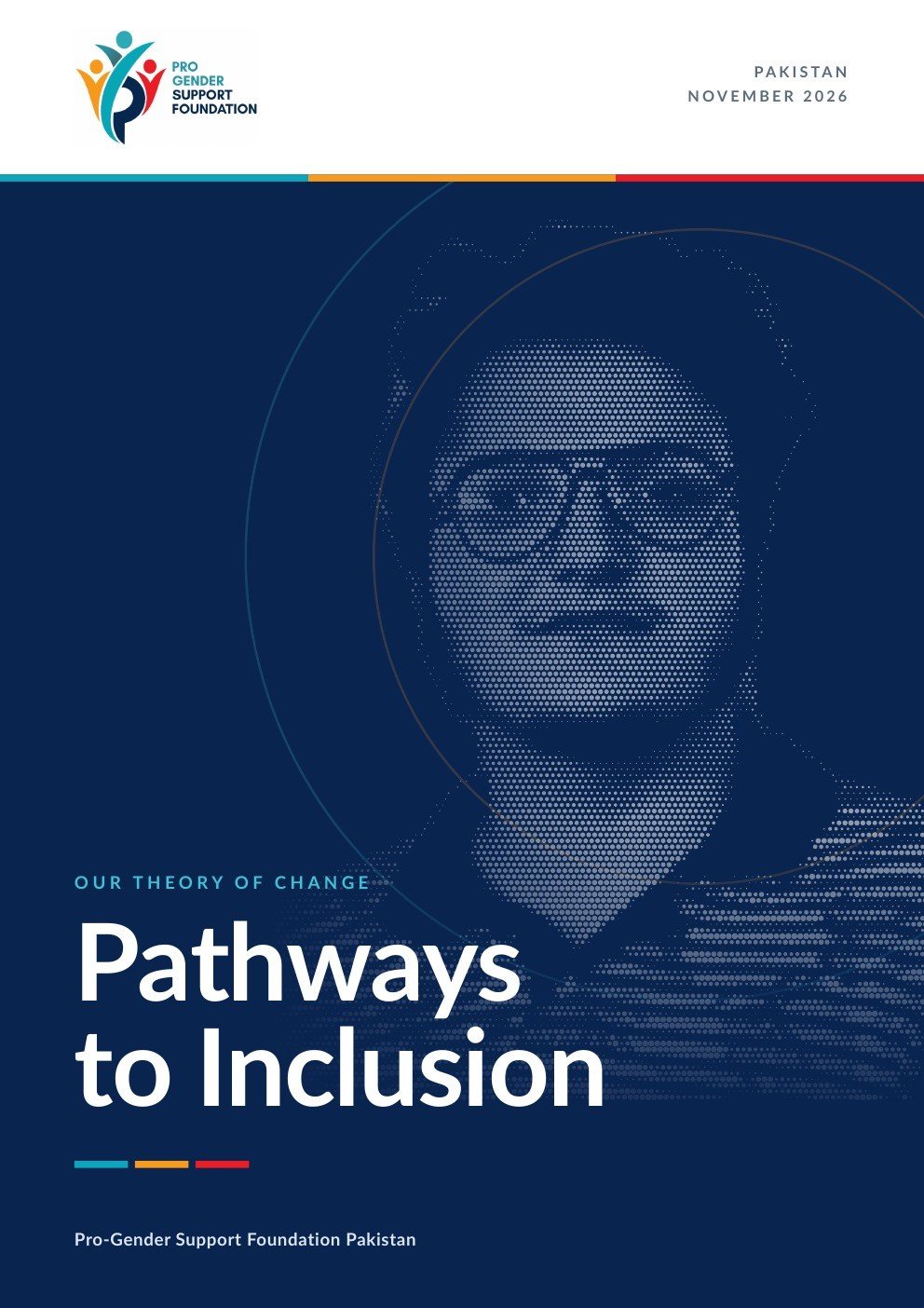
Pathways to Inclusion: PGSF Theory of Change
This theory of change is also available as a designed, printable 12-page brochure to read offline or share with colleagues and partners.
⬇ Download the PDF (3 MB)About the publicationWork with us on this change
Partner with PGSF to turn this theory of change into results for people of all genders across Pakistan.